
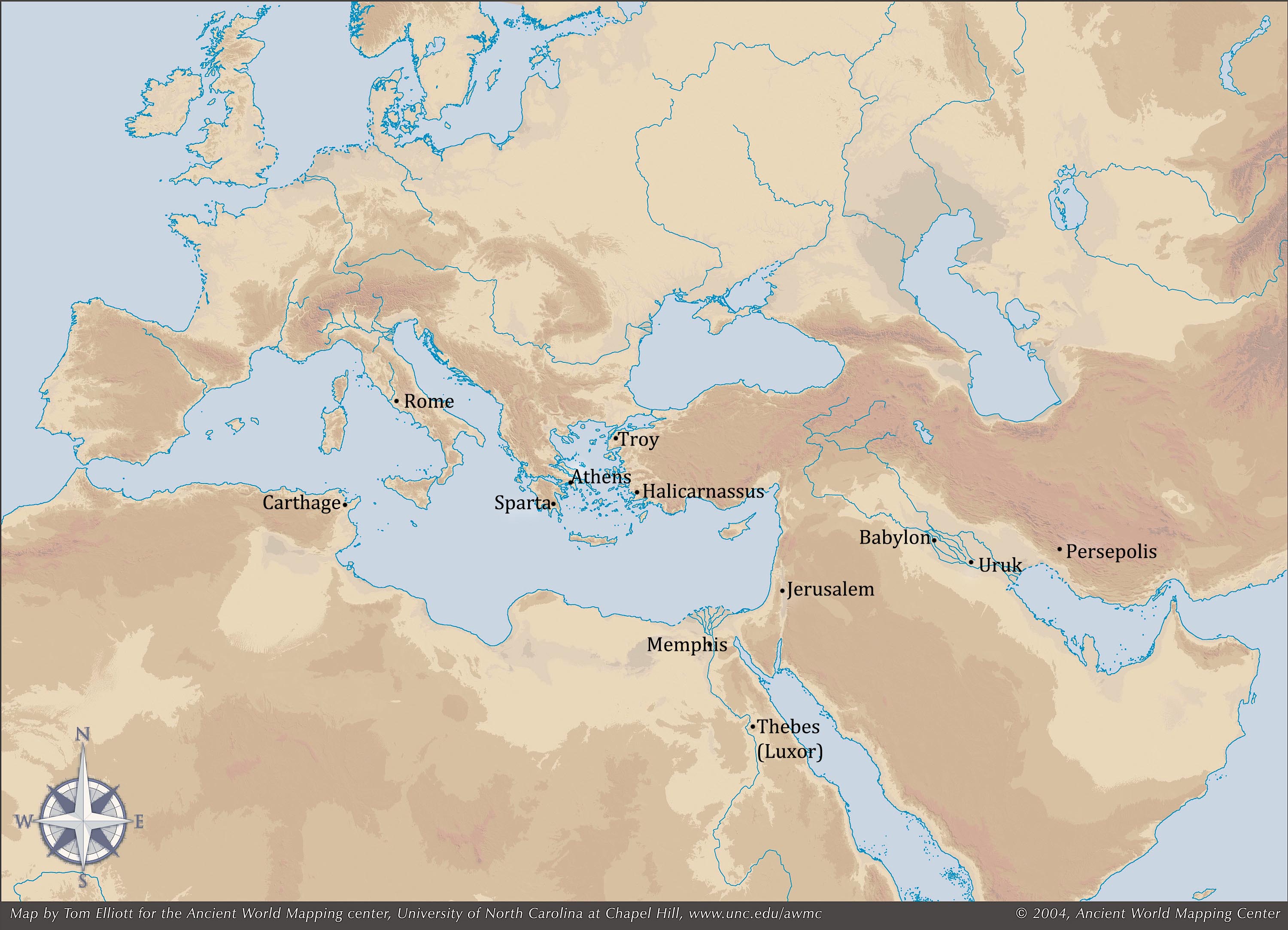
By the end of the second century, isn’t it ironic that Jerusalem, Antioch and Rome were being taught by the Christians from Carthage (over 2,000 miles from Jerusalem)? It was in Africa that the first critical teachings and explanations of Scripture were shaped. The African Fathers were first to interpret the Bible literally. Tertullian, Cyprian, Augustine and others declared THE DOCTRINE OF THE TRINITY (the Father, Son and Holy Spirit) as well as CHRISTOLOGY (the study of the person and work of Jesus Christ).
During this time they also had to fight major heresies:
Gnosticism:
Basically, the Gnostic believes in acquiring special, mystical knowledge as the means for salvation. According to Gnostic beliefs, there is a Great God that is good and perfect, but impersonal and unknowable. The creator of the universe was actually a lesser deity—a cheap knock-off of the “true God”—who wanted to create a flawless material universe but botched the job. Instead of having a utopia, we ended up with a world infected with pain, misery, and intellectual and spiritual blindness; all matter is now corrupt and evil. However, when this lesser deity created man, he accidentally imbued humanity with a spark of the “true” God’s spirit, making man an inherently good soul trapped in the confines of an evil, material body. – Gotquestions.org
Arianism:
Arianism is a heresy named for Arius, a priest and false teacher in the early fourth century AD in Alexandria, Egypt. One of the earliest and probably the most important item of debate among early Christians was the subject of Christ’s deity. Was Jesus truly God in the flesh, or was Jesus a created being? Was Jesus God or not? Arius denied the deity of the Son of God, holding that Jesus was created by God as the first act of creation and that the nature of Christ was anomoios (“unlike”) that of God the Father. Arianism, then, is the view that Jesus is a finite created being with some divine attributes, but He is not eternal and not divine in and of Himself. – Gotquestions.org
Montanism:
Montanism is named after a man named Montanus who became a convert to Christianity around A.D. 170. He lived in Asia Minor, and, prior to his conversion, he was a priest in an Asiatic cult called Cybele. He claimed that he had the gift of prophecy, prophesying in an ecstatic state. Eusebius, a church historian born around A.D. 260-270, wrote the following of Montanus: “In his lust for leadership, he became obsessed and would suddenly fall into frenzy and convulsions. He began to be ecstatic and speak and talk strangely, and prophesied contrary to that which was the custom from the beginning of the church. Those who heard him were convinced that he was possessed. They rebuked him and forbade him to speak, remembering the warning of the Lord Jesus to be watchful because false prophets would come” (Eusebius, Ecclesiastical History, 5.16.1). Montanus was joined by two women, Priscilla and Maximilla, who also claimed to have the gift of prophecy and also prophesied in an ecstatic state.
It was not the idea of prophecy that caused a great disturbance in the church. It was the manner in which they prophesied. They had departed from the biblical norms of prophecy, both in content and in the manner in which they expressed their prophesies. They as a trio believed that they had received revelation from the Lord while being in an ecstatic state. This style of prophesying was likened to the same irrational, ecstatic prophetic style that was a part of Montanus’ life prior to his conversion when he was a priest of Cybele. – Gotquestions.org
Marcionism:
Marcionism was a religious movement based on the teachings of the 2nd-century heretic Marcion of Sinope. While none of Marcion’s writings have survived to the present, we know of his teachings through several early Christian writers including Justin Martyr (AD 100—165), Irenaeus of Lyons (AD 130—200) and Hippolytus (AD 170—235). These men combatted Marcion in defense of the truth.
Marcion held to many errant views, but he is primarily known for his belief that the Old Testament Scriptures were not authoritative for a Christian. He denied that the God of the Old Testament was the same God presented in the New Testament. For Marcion, Jesus was the Son of the God of the New Testament but not the Son of the deity described in the Hebrew Scriptures. The deities of the Old and New Testamentswere, from Marcion’s perspective, literally two different gods. Marcion did not deny the existence of the god of the Old Testament (what he referred to as a Demiurge). He simply classified this god as a secondary deity, one that was inferior to the supreme God revealed in Jesus.
Marcion held that Jesus was the only revelation of the Supreme God but that Jesus should not be seen as having fulfilled Old Testament messianic prophecies. Rather, Marcion saw the prophecies as predicting a yet-to-come earthly savior of the Jewish nation. What Marcion was endorsing was a radical discontinuity between Old Testament Judaism and the message of Jesus and the apostle Paul. Marcion also affirmed a form of Docetism, a view that Jesus was not truly a man but only appeared to be human. This in spite of the clarity of verses such as John 1:14 and 1 John 4:1–3, which speak plainly of Jesus’ true humanity. – Gotquestions.org
Manichaeism:
Manichaeism (also known as Manichaeanism and Manicheanism) is an ancient religion that arose several centuries after Christ. The faith was a purposeful blend of Zoroastrianism and Christianity, borrowing concepts and terminology from both. Manicheans believed that the universe was dominated by two competing forces of good and evil, represented by light and darkness, respectively. While the religion of Manichaeism did not survive very long, historically speaking, its reputation has endured. The term Manicheanis used today mostly to criticize a viewpoint for being too black-and-white, or overly simplified.
Manichaeism arose in Persia in the middle of the 3rd century. Like other early heresies, such as Gnosticism, it taught that the physical world was inherently evil and that salvation is obtained primarily through knowledge. The founder of Manichaeism is known only as Mani, which is actually a title meaning something like “King of Light” or “Shining One.” His teachings particularly criticized Christianity. Mani took specific issue with the Bible for suggesting that some truths in the universe might not be easily understood by human beings.
Manichaeism has far more in common with faiths such as Zoroastrianism than with Christian theology. Other than certain words and phrases, there is little connection between the Bible and the teachings of Mani. – Gotquestions.org
Having been raised in Carthage, Cyprian was taught not to believe in God (other than the Roman gods and the god Caesar). Being wealthy and the son of a Roman politician, Cyprian was able to get a very good, but wordly, education. By the time he was an adult he lived in the wealthy upper class, independent from his family.
Even though he was well-to-do, he experienced disappointment and dissatisfaction with life, seeing corruption and immorality around him every day. He found himself at a spiritual crossroads (many years later, Blaise Pascal would say “there is a God-shaped vacuum in the heart of every man, that only God can fill.”). In his mid-forties, he met a man named Caecilius who told him the gospel, Cyprian repented of his sins and trusted Jesus Christ as his savior and he found contentment at once.
Without delay, Cyprian turned his back on the way that he had been living and donated all of his wealth to the needy.
“By his works, Cyprian showed that he was radically converted and sold out for Christ”. -Anonymous
Cyprian became an ardent student of Christianity. He began to read the Bible and other Christian literature, including the better theologians, of which he referred to Tertullian as the master!
“Cyprian was accustomed never to pass a day without reading Tertullian”.
– Jerome
He wanted nothing more greatly that to have a relationship with God and to be proficient and seasoned in the Word of God.
In under three years, he was granted with overwhelming approval, acceptance and endorsement from the provincial Bishops, the position of Bishop of Carthage. He immediately found himself ‘head to head’ with some of the more senior clergy…leaders like, Fortunatus and Donatus, who were bitter that ‘a Christian, new to the faith’ could so quickly be escalated to a position above them.

The following year saw a major Christian persecution from the Romans. Over the last couple centuries there had been smaller persecutions, however, with Emperor Decius came the first assault on Christians, extending the entire length and width of the empire, since the church’s beginnings.
The most important temple in ancient Rome was the Temple of Capitoline. It was here that Decius required all citizens to offer sacrifices, annually, to Jupiter and the Roman gods. All who would refuse were guilty of treason and as a penalty they would have their belongings removed and ultimately put to death.
This was the most fierce trial that the young church had endured. In the face of persecution, numerous Christians ‘caved-in’ to the demands of Decius. These Christians became known as “the lapsed” while those who held firm were known as “the confessors”. Even the Christians who caved-in still believed themselves to be followers of Jesus Christ, and many of them would later profess Christ, a second time.
Cyprian would not obey the decree of Caesar, and in order to save his life, escaped from Carthage. Many expressed their contempt and described him as a coward for not staying, as many other Christians stayed and endured. While he was gone, he still kept in close touch with the church as much of his flock was put to death. In his correspondence he also counseled other bishops with the problems they were facing during this very difficult time.
Cyprian returned to Carthage the following year. Calling a council, he wanted to resolve this issue of the “lapsed”. The council agreed that those who had sacrificed to the false gods, could return to the church after a period in which their repentance could be shown to be genuine.
He held other synods at Carthage to settle disagreements and doctrinal matters. The entire Roman Empire knew him as a major teacher of Christianity.
Six years after his return to Carthage, in A.D. 257, Emperor Valerian began another round of intense and unrestrained persecutions against the Christians. He required the absolute worship of Roman gods and would not allow Christians to gather to worship the true God. As the bishop of Carthage, he was ordered to appear before the Roman authorities and it was demanded that he involve himself in the pagan ceremonies and worship of Roman gods. He refused. He was then asked for the names of the individuals in his flock. Again, he refused, so on August 30, 257 he was exiled to Curubis (a town in modern Tunisia).
The following summer, Cyprian was allowed to come back to his ministry. However, on September 14, 258 the proconsul, Galerius Maximus, called for Cyprian to appear before him. He was ordered to sacrifice to the pagan gods and to deny Christ. Once again, he refused to deny God and it was pronounced that he would be beheaded.
His beheading took place immediately, in public. Many people followed Cyprian on his last journey. He knelt to pray, put his own blindfold on and was beheaded with a sword.
“In the writings of Cyprian there is an increasing tendency towards the doctrine of the original sinfulness of man, and of a monergistic renewal of the soul.”
“In short, Cyprian was one of the first to emphasize the sovereignty of grace over the dead will and, like other African Fathers, served as a gradual preparation for the Augustinian view of sin and grace.”
– Louis Berkhof
“Cyprian is the most lauded commentator on the divine declarations…the loveliest of teachers…so memorable a teacher of the word of truth…the most luminous doctor…he preached the true grace of God as it should be preached, that is, the grace by which no human merits precede…along with Ambrose, he is the most excellent commentator on the word of God.”
– Augustine
“I have a high regard for St. Cyprian’s person and faith, he is among the most outstanding Fathers and greatest Theologians”.
– Martin Luther
“Be constantly committed to prayer or the reading of Scripture; by praying, you speak to God, in reading, God speaks to you”.
– Cyprian
“If He prayed who was without sin, how much more it becometh a sinner to pray”.
– Cyprian
“In proportion to the size of the vessel of faith, brought by us to the Lord, is the measure we draw out of his overflowing grace”.
– Cyprian
.
 The Conservative Christian